Production Downtime and Operator Response: What Causes Slow Reactions – and How to Reduce Downtime.

16. July 2025

In this article

Despite high levels of automation, production downtime still occurs. The reasons are diverse. In addition to operator errors, hard-to-measure product and packaging properties (e.g., the random distribution of nuts in chocolate or varying carton moisture) can cause process fluctuations. Because it is generally more economical —but more error-prone— to run processes as close as possible to the physical limits, these fluctuations often lead to micro-stoppages that operators must address.

This article explains why there are significant differences in operators’ response capabilities and how the duration of unplanned production downtime can be significantly reduced by intelligently combining automation with human knowledge.
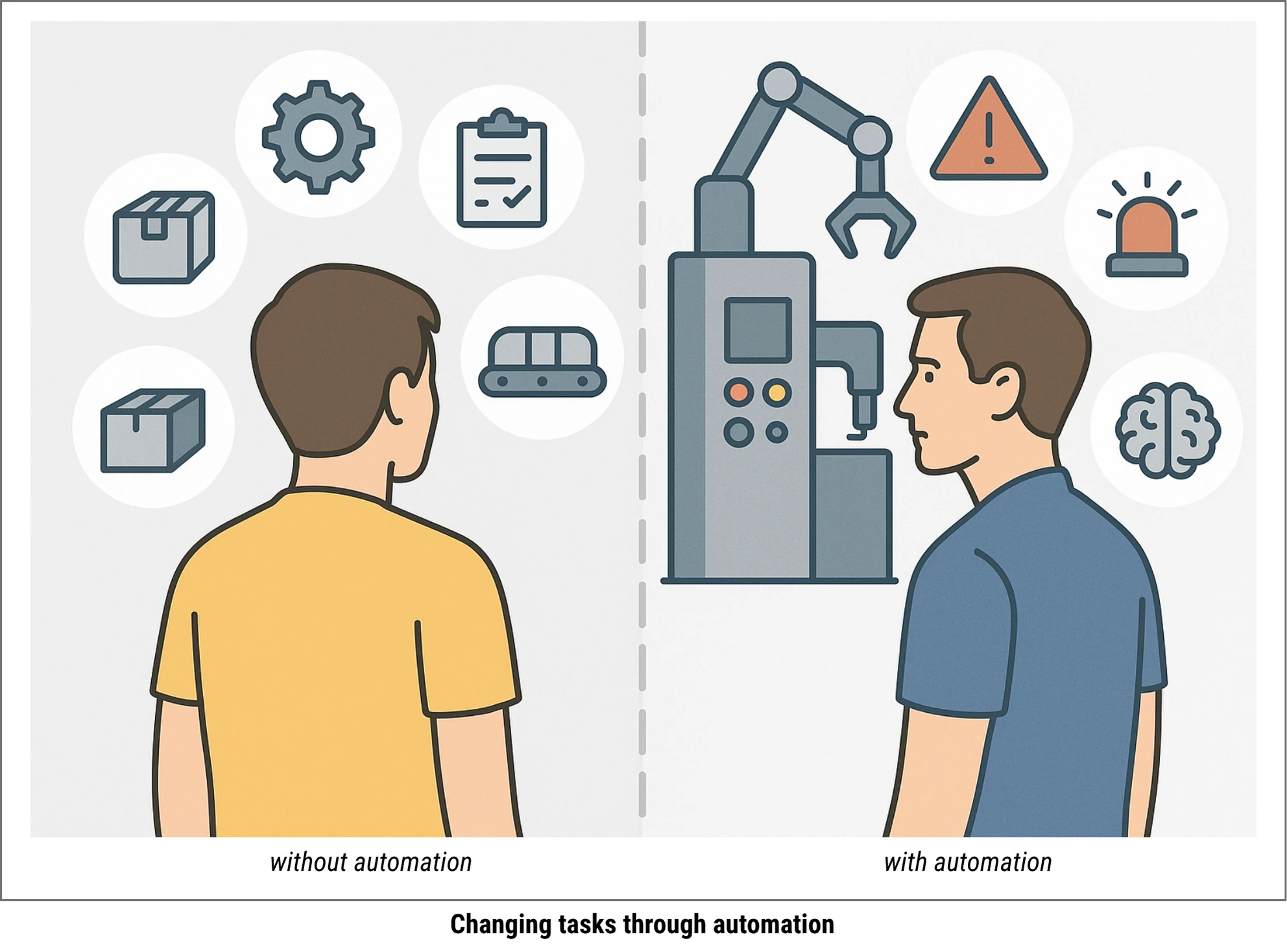
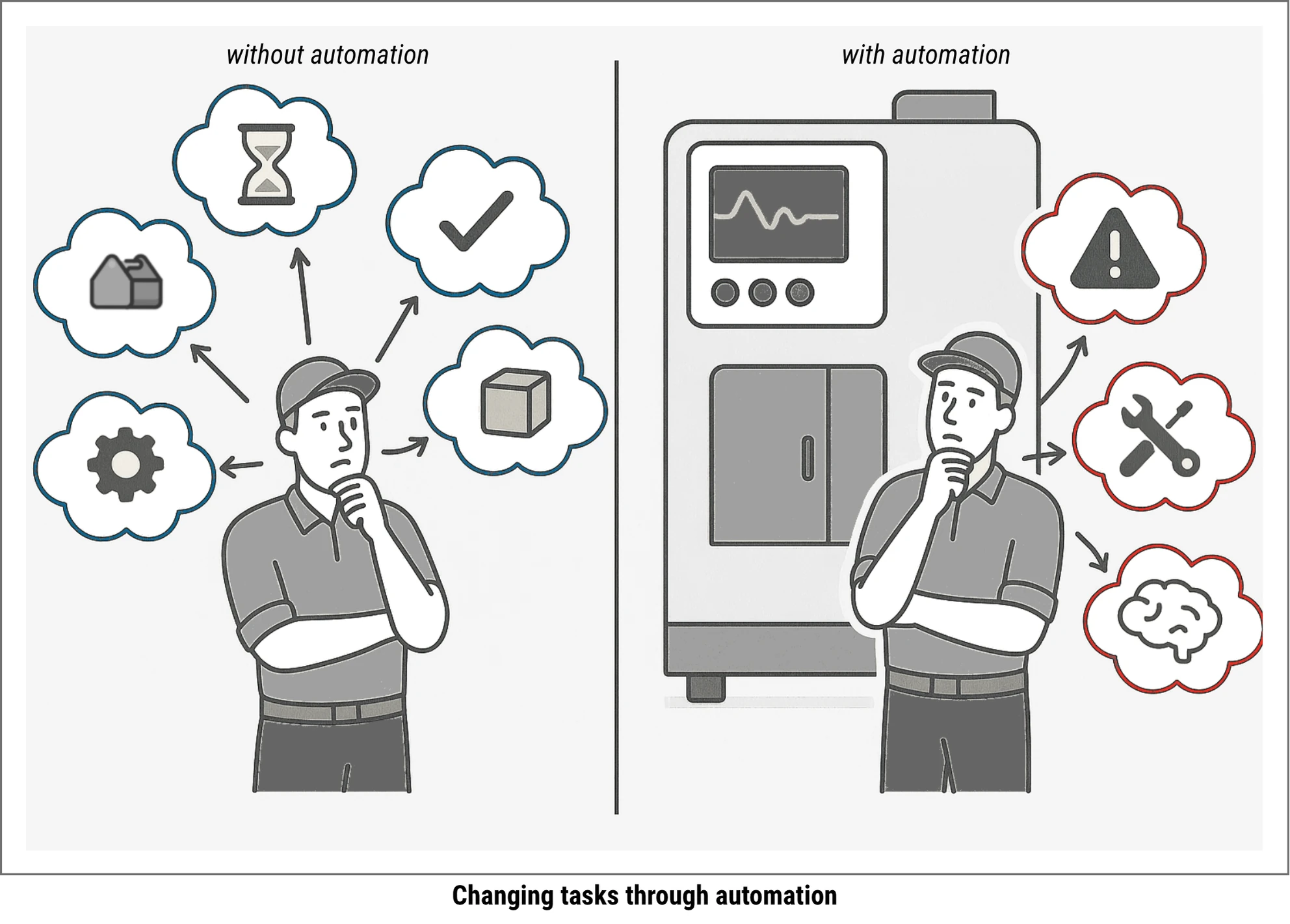
The Ironies of Automation – Why Technology Alone Can't Prevent Production Downtime.

Illustration of Cognitive Demands on Machine Operators With and Without Automation in the Context of Production Downtime.
The basic idea behind it: automation is meant to reduce human errors, yet it ironically introduces new risks. Three key aspects define this concept:
  1. Automated systems are designed by humans – and this is precisely where planning or programming errors can occur.
  2. When technology fails, it is still the human who must intervene. However, because operators have mostly taken a passive role beforehand, they often lack the practical experience needed to react quickly and correctly in critical situations.
  3. Effective problem-solving requires the operator to have an up-to-date understanding of the situation, deep process knowledge, and confidence in taking action. Yet these skills deteriorate when operators spend long periods only observing and rarely engaging actively.
What was once formulated as a theoretical observation is now evident in many production facilities as a real cause of prolonged response times – and ultimately, preventable production downtime.

Between Wishful Thinking and Reality: Why Automation Weakens Human Response Capabilities

Comparison of Employee Tasks Without and With Automation in the Context of Production Downtime.

The idea of a completely error-free, self-regulating production process is persistent, yet reality shows that even in highly automated plants, humans remain an indispensable factor for success. Production downtime often occurs precisely when this fact is overlooked.

For a long time, the division of tasks between humans and machines followed a simple rule: technology handles everything that can be reliably automated, while humans take care of flexibility and improvisation.

Today, however, a new conflict emerges: the more tasks machines take over, the less often operators need to intervene – yet when they do, it is usually in particularly critical situations.

The problem: these rare interventions require full attention, rapid analytical skills, and comprehensive process knowledge – all of which suffer when humans are scarcely involved in process control over long periods.

A human-machine system is more than just the sum of its parts. When tasks are removed, performance in the remaining tasks is directly affected. This connection is often underestimated in practice – with noticeable consequences: delayed reactions and longer production downtime during critical moments.

How Peerox Effectively Combines Humans and Automation.

At Peerox, it was clear from the concept phase that successfully reducing production downtime is only possible if the role of humans in the system is considered from the very beginning. A concrete example of this is a feature within our software that suggests relevant knowledge cards for recurring issues. A machine learning algorithm analyzes past operator feedback as well as patterns in machine and process data, calculating the probability that a card is relevant to the current situation.
Features like these are no coincidence; they reflect a fundamental design principle at Peerox: the entire system is designed to deliberately support human-machine interaction, always aligned with the cognitive abilities of the users. Our goal is not just to provide technical assistance, but to actively enhance operators’ decision-making and reaction speed – sustainably reducing production downtime.

If you want to learn how to better support your operators in critical situations and prevent production downtime, we’d be happy to show you live.

Book a free, no-obligation demo now and see MADDOX in action!

You might also like

Bar Chart: Development of Average Downtime for Different Error Codes

Peerox Delivers: Boosting Efficiency at Rotkäppchen-Mumm with AI-Driven Knowledge Management

Visual comparison of modern smart knowledge documentation in production versus traditional methods

How Detailed Should Knowledge Documentation Be in Production?