03. February 2026
2026 marks a turning point for manufacturing in Europe. Starting August 12, the new EU Packaging and Packaging Waste Regulation (PPWR) takes effect—bringing mandatory requirements for recyclability and compliance documentation that go far beyond current standards. At the same time, demographic shifts are reaching a critical threshold: the large Baby Boomer generation is retiring, taking decades of accumulated expertise with them as they leave the factory floor.
Either of these developments alone would pose a significant challenge. But their convergence creates a situation that puts many companies in a structural bind: rising regulatory complexity meets shrinking workforces and fading institutional knowledge. The question of who will have the know-how to implement new compliance requirements is becoming a core strategic concern.
This article examines how these two megatrends intersect and explains why knowledge management and AI in manufacturing are no longer optional modernization projects—they’re becoming operational necessities. Using the pharmaceutical packaging industry as an example—a sector that’s traditionally both heavily regulated and conservative in its approach—we’ll show how digital assistant systems are already helping companies preserve institutional knowledge, streamline processes, and reliably meet regulatory requirements.

With Regulation (EU) 2025/40—commonly known as the PPWR (Packaging and Packaging Waste Regulation)—the European Union has established an entirely new legal framework for packaging and packaging waste. The regulation was adopted on December 19, 2024, published in the Official Journal of the EU on January 22, 2025, and officially entered into force on February 11, 2025. It becomes fully enforceable across all member states on August 12, 2026. The complete regulatory text is available at eur-lex.europa.eu.
Unlike the previous EU Packaging Directive 94/62/EC, which had to be transposed into national law by each member state, the PPWR applies directly and is immediately binding. National regulations will give way to uniform European standards—a paradigm shift that creates legal clarity while requiring significant adjustments within companies.
The core requirements of the PPWR can be summarized across three dimensions.
First, comprehensive documentation requirements are being introduced. Starting August 12, 2026, every package placed on the market must have an EU Declaration of Conformity in accordance with Article 39 of the regulation. This requires a conformity assessment procedure along with technical documentation per Annex VII, which must include a description of the packaging, its intended use, and the materials used. These documents must be retained for five years for single-use packaging and ten years for reusable packaging, and must be made available to market surveillance authorities upon request.
Second, the PPWR establishes binding sustainability targets. By 2030, all packaging must be designed for recyclability. Plastic packaging is subject to phased minimum requirements for post-consumer recycled content. Additionally, starting in 2030, empty space in shipping and transport packaging will be capped at 50 percent—a measure that particularly affects e-commerce.
Third, the regulation establishes clear role definitions across the entire packaging lifecycle. Producers, manufacturers, importers, and distributors each have specific obligations assigned to them. This polluter-pays approach to responsibility ensures that sustainability isn’t just stated as an abstract goal but is operationally embedded.
For manufacturing companies, this means existing processes must be reviewed, documentation systems expanded, and employees trained. The question of who will build and maintain this knowledge leads directly to the second megatrend hitting the industry at the same time.
While regulatory requirements are ramping up, the manufacturing industry is simultaneously facing a workforce upheaval of historic proportions. The large Baby Boomer generation—employees born between 1955 and 1969—will reach retirement age in the coming years. Their departure means companies are losing not just a significant number of workers in quantitative terms, but also an enormous body of hands-on expertise in qualitative terms.
The numbers illustrate the scale of the issue: according to the German Federal Statistical Office, the share of older workers has been growing steadily. While 20 percent of the workforce was 55 or older in 2014, that figure had already climbed to over 26 percent by 2024. Germany now has one of the highest proportions of older workers in Europe. Over the next 10 to 15 years, these cohorts will gradually retire—and the generations coming up behind them simply can’t fill the gap in terms of headcount.
The manufacturing sector is particularly hard hit. Roughly 1.7 million employees between the ages of 55 and 65 currently work in this sector—representing 22 percent of all older workers in Germany. Industries like mechanical engineering, chemical and pharmaceutical manufacturing, and packaging technology are especially affected by these demographic shifts.
What makes this development so critical is the nature of what’s at risk of being lost. To understand this, it helps to look at the “knowledge stairway” described by Klaus North. It draws a fundamental distinction between information and knowledge. Information—facts, procedures, measurements—can be documented in manuals, ERP systems, photos, or videos. Knowledge, on the other hand, only emerges when multiple pieces of information are connected within a specific context. And that connection can’t simply be written down.
A practical example illustrates the difference: an experienced machine operator hears a rattling noise from the equipment. First thought: the belt might be too loose. But she also knows that butter cheese is currently being processed—a material that sticks heavily to the belt and can cause a similar noise even when the tension is correct. Her assessment: it’s probably fine.
This conclusion connects multiple layers of information in a split second: acoustic pattern recognition, mechanical understanding of belt tension, material properties of butter cheese, and the current production context. None of these pieces of information alone would lead to the right conclusion—only their integration produces actionable knowledge.
These kinds of complex connections can only be stored in highly networked systems: the human brain—or machine learning models. On paper, in databases, or in traditional documentation systems, all that remains is the information, not the knowledge.
This is precisely where the structural problem of demographic change lies: when experienced employees leave a company, what’s lost isn’t just documentable information but, more importantly, the mental integration that happens in their heads—the ability to draw the right conclusion from many individual pieces of information at the right moment. New employees need years to build comparable expertise—time that simply isn’t available given the skilled labor shortage and rising regulatory demands.

The consequences become clear when you look at a specific example: the PPWR doesn’t just demand comprehensive documentation—it also implies specific technical measures for machinery and equipment. To demonstrate the required conformity, production processes must be precisely monitored, parameters documented, and deviations recorded in a traceable way.
Here’s a real-world example: traditional multilayer packaging combines materials like PET/OPA as an outer, high-temperature-stable layer with a low-melting PE sealing layer on the inside. This allows for sealing temperature process windows of 20–30°C, resulting in robust, forgiving processes. But because the layers can’t be separated, this type of packaging is essentially non-recyclable and must be replaced with mono-materials (such as mono-PE or mono-PP). With these materials, the difference between “properly sealed” and “burned through or over-sealed” is often just 2–5°C.
These narrow process windows create demanding requirements for stable process control. Times, temperatures, and pressures must be maintained with precision. Minor disruptions to heat transfer—even slight contamination on the sealing tool or sealing surfaces—immediately cause production problems. Making matters worse, recycled materials are increasingly being used, and their properties (thickness, polymer chain molecular weight distribution, etc.) vary even more than traditional films.
Combined with the very narrow process windows, this severely limits traditional approaches to process optimization—such as centerlining. There’s no single set of optimal process parameters. Instead, experienced operators must continuously readjust for each new batch based on hands-on know-how.
These kinds of adjustments require more than just technical equipment—they demand the kind of interconnected knowledge that currently exists only in the heads of experienced employees. Traditional approaches to knowledge transfer—onboarding by senior colleagues, informal sharing during day-to-day work, training sessions led by internal experts—are hitting their limits under these conditions. There’s little time for an orderly handover, the complexity of requirements is high, and skilled workers coming up through the ranks are scarce.
Companies now face a dual challenge: building new compliance expertise while preserving existing operational know-how—before it’s lost for good. Meeting this challenge will require new tools.

Given this dual challenge, one question takes center stage: how can hands-on expertise be systematically captured before it leaves the company—and how can that knowledge be prepared in a way that keeps it accessible and usable even as regulatory requirements increase?
The answer lies in combining networked knowledge management with artificial intelligence. To clarify terms: artificial intelligence (AI) is the broad category for systems that perform cognitive tasks like pattern recognition, decision-making, or language comprehension. Machine learning (ML) is a subdiscipline of AI: instead of explicitly programming rules, ML systems learn relationships from data.
Traditional documentation systems—wikis, manuals, training videos—don’t fail due to lack of diligence. They fail because of a structural limitation: they can store information, but they can’t create connections. And it’s precisely those connections that turn information into knowledge.
AI-based knowledge management systems like MADDOX solve this problem through a specific two-component architecture.
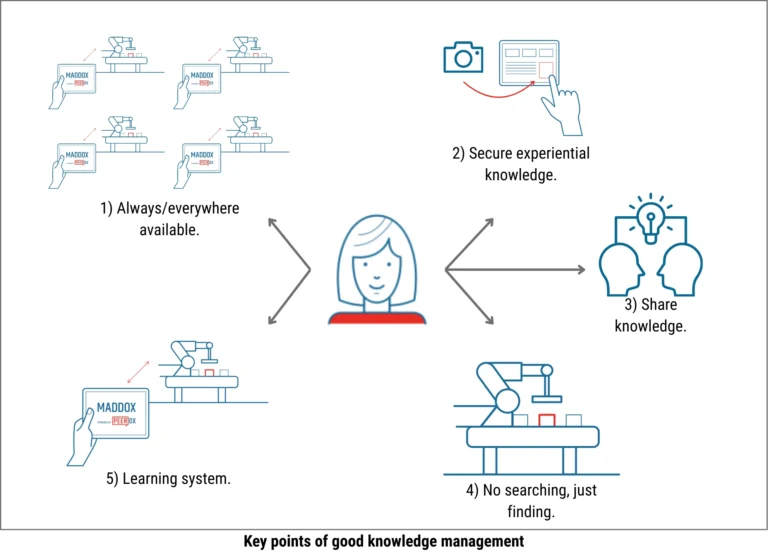
The content database stores information in the form of knowledge cards—text, images, and videos covering incidents, solutions, material specifics, and equipment quirks. Experienced employees can contribute their expertise without having to write manuals.
The machine learning model handles the connection-building. It learns relationships between stored information and relevant contextual data—whether that’s machine states, material batches, environmental conditions, or process parameters. This ability to make context-dependent connections was previously something only the human brain could do.
Content database + ML model for information networking = knowledge repository.
In practice, this means the system doesn’t deliver an unstructured pile of documents. It provides context-aware recommendations tailored to the current situation. Previous incidents with similar patterns, proven solutions, and notes on known quirks aren’t just retrieved—they’re connected. The expertise of long-tenured employees is preserved not as static information, but as applicable, networked knowledge.
A company that captures its operational expertise this way gains more than just protection against demographic shifts. It creates a foundation where new employees get up to speed faster, where regulatory requirements can be met with consistent quality—and where collective know-how is no longer locked inside individual heads.
These ideas aren’t just theoretical—a look at real-world applications proves it. In an episode of the Packaging Valley podcast “Verpackt und Zugeklebt,” Matthias Markus, Head of Pharmaceutical Packaging Technology at Bayer AG, and Andre Schult, Founder and CEO of Peerox GmbH, share their experiences with digital assistant systems in pharmaceutical packaging production.
The starting point is typical for the industry: pharmaceutical packaging is heavily regulated, complex, and traditionally conservative. This combination makes digitalization particularly challenging—but also opens up significant opportunities.
In the conversation, Markus and Schult explore how the AI-powered assistant system MADDOX works in day-to-day production, what role employees play in the process, and what results the collaboration between a startup and a major corporation has delivered.
Digital assistant systems can measurably improve Overall Equipment Effectiveness (OEE) by identifying disruptions faster and providing solution knowledge on the spot. At the same time, they enable systematic preservation of hands-on expertise—an aspect that’s becoming increasingly important as the workforce ages out.
How well this approach works is reflected in a recent recognition: the joint project between Bayer and Peerox was awarded the maintenance Instandhaltungspreis 2025—presented at maintenance Munich as a model for the entire industry.
The podcast offers a concrete look at how the challenges outlined in this article can be addressed in real-world operations. The full episode is available on Spotify and Apple Podcasts.